How do you run a proper A/B test on ads and landing pages?
A proper A/B test changes one thing, splits traffic randomly between the original and the variant, and runs until a sample size you calculated in advance is reached, in whole weeks. You decide the hypothesis, the success metric and the stopping rule before launch, and you do not call a winner just because a dashboard turned green partway through.
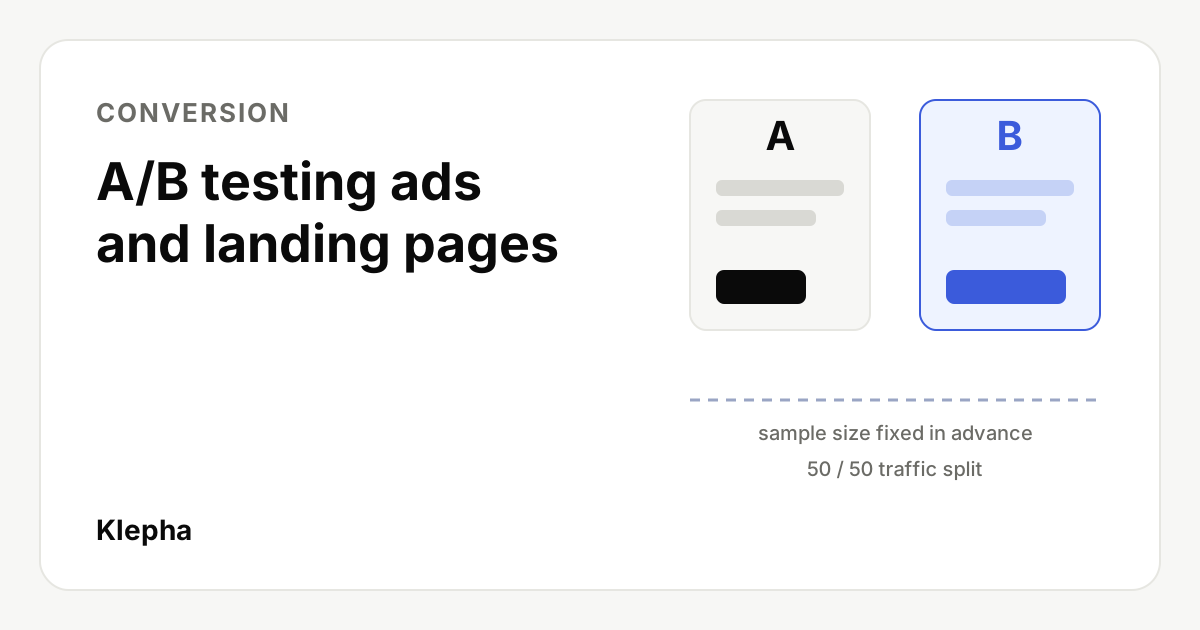
To run a proper A/B test on ads or landing pages, write a hypothesis, pick one success metric, calculate how many visitors or clicks each version needs, split traffic randomly and evenly, and run the test for whole weeks until that sample is reached. Then read the result once, against the plan you wrote before launch.
Most bad tests fail on the last step. Someone checks the results every morning, sees version B ahead with "95% significance" on day four, and ships it. Evan Miller's widely cited essay "How Not To Run an A/B Test" explains why that is a trap: significance figures assume you decided the sample size in advance, and repeatedly peeking and stopping on the first significant reading inflates the false positive rate well beyond what the dashboard reports. Everything below is designed to avoid fooling yourself.
Key takeaways
- One change, one primary metric, written down with the expected effect before launch.
- Calculate the sample size first. Small expected lifts on low conversion rates need far more traffic than most teams expect.
- Run in whole weeks, at least one full business cycle, and stop at the planned sample, not at the first green number.
- Report a range, not just a winner. A confidence interval shows how big the effect could plausibly be.
- In Google Ads, use Experiments, which split a campaign's traffic and budget so both versions run over the same dates.
What is an A/B test?
An A/B test is a controlled experiment that shows two versions of something, the control (A) and a variant (B), to randomly assigned groups of people at the same time, and compares an outcome such as conversion rate. Random assignment is what makes it a test: because both groups are alike on average, a difference in outcome can be credited to the change rather than to timing, audience or luck, within a known margin of error.
A before and after comparison is not an A/B test. If you change a landing page on Monday and compare this week with last week, seasonality, budget changes, competitor activity and algorithm updates are all mixed into the result.
How do you write a good A/B test hypothesis?
A useful hypothesis names the change, the metric, the expected size and the reason. A simple template:
Because [evidence], we believe that [change] for [audience] will [increase or decrease] [primary metric] by at least [minimum effect]. We will know after [sample size] visitors per variant.
For example: "Because session recordings show most mobile visitors never scroll to the form, we believe moving the form above the fold on the demo page will raise mobile form completion from 3.0% to at least 3.6%." The evidence part keeps you testing ideas with a reason behind them, and the minimum effect feeds straight into the sample size calculation.
What should you test first on ads and landing pages?
| Asset | High impact tests | Usually low impact |
|---|---|---|
| Search ads | Offer or value proposition in headlines, price or proof points, matching the landing page promise | Swapping synonyms, punctuation |
| Social ads | Creative concept, first three seconds of video, audience pain point | Small color changes |
| Landing pages | Headline and offer, form length, proof near the call to action, page that matches ad intent | Button color, minor copy edits |
| Campaign settings | Bidding strategy, match types, audience expansion | Several settings changed at once |
Bigger, bolder changes produce bigger effects, and bigger effects need much smaller samples to detect. On low traffic, testing a new offer is realistic; testing a button color is not. Our guide to landing pages that convert paid traffic lists the page elements that usually matter most.
How big does the sample need to be?
Sample size depends on three inputs: your baseline conversion rate, the smallest effect you care about detecting (the minimum detectable effect) and how much risk of a wrong answer you accept. The usual defaults are a 5% significance level, meaning a 5% chance of declaring a difference that is not real, and 80% power, meaning an 80% chance of detecting a real effect of the size you specified.
A common rule of thumb for those defaults is that each variant needs roughly 16 × p × (1 − p) ÷ d² visitors, where p is the baseline conversion rate and d is the absolute difference you want to detect. The table applies it to a few scenarios:
| Baseline conversion rate | Lift to detect | Absolute difference | Visitors per variant (approx.) |
|---|---|---|---|
| 2% | +50% (to 3%) | 1.0 point | 3,100 |
| 2% | +20% (to 2.4%) | 0.4 points | 19,600 |
| 5% | +20% (to 6%) | 1.0 point | 7,600 |
| 5% | +10% (to 5.5%) | 0.5 points | 30,400 |
| 10% | +10% (to 11%) | 1.0 point | 14,400 |
Klepha calculation using the rule of thumb above for a two-sided test at 5% significance and 80% power. Dedicated calculators give slightly different figures; use one for real tests.
The pattern matters more than the exact numbers. Halving the effect you want to detect roughly quadruples the sample you need. A page with 2% conversion and 1,000 visitors a week cannot reliably detect a 20% lift in any reasonable time, so either test a bolder change or measure a metric that happens more often, such as clicks to the form, and confirm the downstream effect later.
How long should an A/B test run?
Divide the total sample by your weekly traffic to get the number of weeks, then round up to whole weeks. Running in full weeks matters because weekday and weekend visitors often behave differently, and a test that covers four weekdays and no weekend measures a skewed audience. As a working rule:
- At least one full week, and ideally two, even if the sample is reached sooner.
- Long enough to cover your sales cycle if the metric is a lead or purchase that happens days after the click.
- Not much longer than about four to six weeks, because cookies expire, people switch devices and the outside world changes, which all add noise.
- Avoid unusual periods, such as a major sale or a Google core update rollout, when traffic mix shifts for reasons unrelated to your change.
Write the stop date down before you launch. If the calculated length is many months, the test is not feasible as designed.
Test ideas that start from real buyer questions
A free Klepha report shows the questions buyers ask Google and AI assistants in your category, a better source of ad and landing page hypotheses than guesswork.
Get my free reportHow do you set up ad and landing page tests?
Google Ads
Google Ads custom experiments create a trial version of a campaign that "shares your original campaign's traffic (and budget)," so both versions run over the same dates. Google notes that custom experiments are available for Search, Display, Video and Hotel campaigns, not App or Shopping, and that while you can schedule up to five experiments, "you can only run one experiment at a time." For Search campaigns you can choose a cookie-based split, which keeps each user in one version, or a search-based split. Google also warns that editing the original campaign during the experiment makes results harder to interpret, so freeze other changes.
For copy tests, Google's ad variations feature tests a text change across many ads at once. For bigger structural changes such as match types or bidding, use a custom experiment. If you are deciding whether to widen match types to reach multiturn ads in AI Mode, an experiment is the cleanest way to see the cost.
Landing pages
For page tests, use a testing tool or your site platform to split visitors randomly and keep each visitor in the same version on return visits. Two practical checks: make sure both versions load equally fast, since a slower variant loses for reasons unrelated to its content, and make sure your analytics records which version each visitor saw. If you send paid traffic to two different URLs, tag both with consistent UTM parameters so the results do not split across reports.
Social and other ad platforms
Most major ad platforms offer a built-in split test that divides the audience so the same person does not see both versions. Use it rather than running two ad sets side by side, which compete in the same auction and do not produce a random split.
How do you read A/B test results honestly?
- Read once, at the planned end. Look at interim numbers only to catch broken tracking or a variant that is clearly harming the business.
- Look at the confidence interval, not only the p-value. "B converted 12% better, with a plausible range of 2% to 22%" is more useful than "B won."
- Check the sample split. If you planned 50/50 and got 54/46, something in the setup is wrong; investigate before trusting the result.
- Check guardrail metrics. A variant that raises leads but lowers lead quality, average order value or retention is not a win. Our guide to CAC and LTV shows how to weigh those.
- Treat segments as new hypotheses. If B won on mobile but not desktop, that is a candidate for the next test, not a finding, because slicing results many ways will always turn up some "significant" segment by chance.
- Accept inconclusive results. No significant difference means the effect, if any, is smaller than your test could detect. Keep the simpler version and move on.
Keep a log of every test: hypothesis, dates, sample, result and decision. Over a year, that log is worth more than any single winner, because it tells you which kinds of changes actually move your numbers.
Which traps create false winners?
| Trap | Why it misleads | Prevention |
|---|---|---|
| Peeking and stopping early | Repeated checks inflate false positives beyond the stated significance level | Fix the sample size in advance, or use a sequential or Bayesian method designed for monitoring |
| Testing many variants at once | Each extra comparison adds another chance of a fluke winner | Limit variants, or adjust for multiple comparisons |
| Changing several things in one variant | You cannot tell which change caused the effect | Test one idea at a time, or accept you are testing a whole concept |
| Novelty effect | Returning visitors react to anything new, then revert | Run at least two weeks and compare new versus returning visitors |
| Editing during the test | The test measures a moving target | Freeze budgets, bids and pages for the test period |
| Optimizing a proxy metric | Click-through rate rises while sales do not | Choose a primary metric close to revenue |
Testing is one part of a wider growth system that connects paid, organic and AI search visibility. Our solutions, expertise and case studies pages explain how we run that work, and our guide to Google Ads on a small budget covers what to do when traffic is too low for formal tests.
Sources
- Google Ads Help, "Set up a custom experiment", accessed November 11, 2026. support.google.com
- Google Ads Help, "Set up ad variations", accessed November 11, 2026. support.google.com
- Evan Miller, "How Not To Run an A/B Test", on repeated significance testing and fixed sample sizes, accessed November 11, 2026. evanmiller.org
- Klepha, sample size table calculated November 11, 2026 with the approximation n = 16p(1 − p)/d² per variant (two-sided, 5% significance, 80% power).
Frequently asked questions
How long should an A/B test run?
Run it until the sample size you calculated in advance is reached, in whole weeks, with at least one and ideally two full weeks to cover weekday and weekend behavior. Very long tests of more than about six weeks pick up extra noise from cookie loss and outside changes.
How many visitors do I need for an A/B test?
It depends on your baseline conversion rate and the smallest lift you want to detect. At a 5% conversion rate, detecting a 20% lift needs roughly 7,600 visitors per variant at 5% significance and 80% power, while detecting a 10% lift needs about four times as many.
Why should I not stop a test as soon as it is significant?
Significance figures assume the sample size was fixed in advance. Checking repeatedly and stopping at the first significant reading greatly increases the chance of a false winner, so decide the sample size first or use a sequential method built for monitoring.
What should I A/B test first on a landing page?
Start with changes most likely to have a large effect: the headline and offer, form length, proof near the call to action and how closely the page matches the ad. Small cosmetic changes need very large samples to show any measurable effect.
How do I A/B test in Google Ads?
Use a custom experiment, which splits a campaign's traffic and budget between the original and a trial version over the same dates, or ad variations for copy changes across many ads. Avoid editing the original campaign while the experiment runs.
What if my A/B test is inconclusive?
An inconclusive result means any effect is smaller than your test could detect. Keep the simpler or cheaper version, log the result and test a bolder change next, rather than extending the test until something turns significant.