How do multiturn ads work in Google AI Mode, and how should advertisers adjust?
Multiturn ads are Google Ads that appear on the responses to follow-up questions in an AI Mode conversation, not only on the first query. Google announced them for the US on October 28, 2026, and Search Engine Roundtable saw them live in early November. They run through existing Search, Shopping and Performance Max campaigns, and only AI-powered targeting such as broad match, AI Max and Performance Max can match the exploratory follow-ups where they appear most.
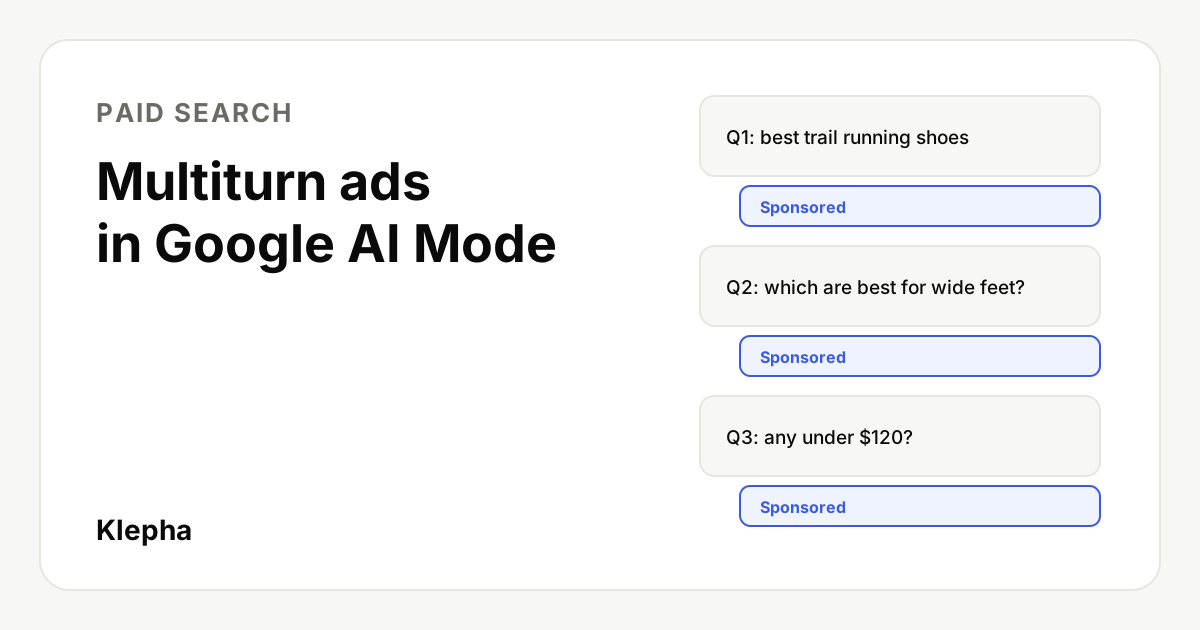
Multiturn ads let Google show Sponsored results on each turn of an AI Mode conversation, so an ad can appear under the answer to a second, third or fourth question as well as the first. Advertisers do not opt in or build new campaigns: existing Search, Shopping and Performance Max campaigns take part automatically through the normal auction, and your keyword match types decide how much of that follow-up traffic you can reach.
That last point is the one that changes planning. Follow-up questions in AI Mode tend to be long and conversational, and Google only matches exact and phrase match keywords to queries that already show direct commercial intent. Broader, exploratory follow-ups are matched contextually, using both the question and the AI answer, and only AI-powered targeting is eligible for that. This guide sets out what Google has confirmed, what you control and how to decide whether to change anything.
Key takeaways
- Announced October 28, 2026 for the US; Search Engine Roundtable reported them live on November 9 after testing on November 6.
- No setup needed. Search, Shopping and Performance Max campaigns are automatically eligible; text and Shopping ads can appear.
- Match type decides reach. Broad match, AI Max, Shopping and Performance Max qualify for contextual matching; exact and phrase only match direct commercial queries.
- You cannot target or exclude AI Mode on its own. Negative keywords, brand exclusions and asset pinning still apply.
- Reporting is blended. AI Mode results sit inside standard campaign and search terms reports, with no separate segment.
What are multiturn ads in Google AI Mode?
AI Mode is the conversational search experience in Google Search where people ask a question, get an AI generated answer with links and then keep asking follow-ups. Before multiturn ads, Sponsored results were tied to a single query. Google's announcement put the change in one line: "To allow ads in follow-up queries in AI Mode, we are launching multiturn ads in the U.S."
A Google spokesperson told Search Engine Roundtable that "multiturn ads show up on responses to follow-up user queries as users engage in back and forth conversations with AI Mode." Every placement is labeled "Sponsored." When Barry Schwartz tested AI Mode, he saw ads under the first query and the follow-up, and additional ads on the third and fourth follow-ups.
When did multiturn ads launch, and where are they available?
| Date | What happened | Source |
|---|---|---|
| May 2025 | Google first launched ads in AI Mode | Search Engine Roundtable |
| October 28, 2026 | Google expanded ads in AI Mode to ten more countries and announced multiturn ads in the US | Google blog (Shashi Thakur) |
| November 9, 2026 | Google Ads shared the expansion of ads in AI Mode to more than 10 new English language countries on its official X account | Search Engine Journal |
| November 6 to 9, 2026 | Multiturn ads observed live in US AI Mode, including on third and fourth follow-ups | Search Engine Roundtable |
| Q4 2026 (planned) | Ads in AI Mode to expand to Brazil, Mexico and the United Kingdom | Google blog |
Multiturn ads were announced for the US. Google's help page lists ads within AI Overviews and AI Mode as available in English in the United States, Australia, Canada, India, Kenya, Malaysia, New Zealand, Nigeria, the Philippines and Singapore, with Indonesia (AI Overviews only) and Pakistan (text ads only), and notes the list may not be exhaustive. It does not say whether multiturn placements extend beyond the US, so treat other markets as unconfirmed.
Which countries now have ads in AI Mode?
Google is expanding ads in AI Mode to more than 10 new countries in English while multiturn ads stay limited to the US. Search Engine Journal reported on November 10, 2026 that Google shared the update from its official Google Ads X account on November 9, following the October announcement. The table below combines the October list with Google's help page as of November 12, 2026.
| Market | Ads in AI Mode | Multiturn ads | Notes |
|---|---|---|---|
| United States | Yes | Yes | Launched first; multiturn announced October 28, 2026 |
| Australia, Canada, India, Kenya, Malaysia, New Zealand, Nigeria, Philippines, Singapore | Yes, English | Not announced | Named in Google's October expansion |
| Pakistan | Yes, English | Not announced | Text ads only, per Google's help page |
| Indonesia | AI Overviews only | Not announced | Listed on the help page for ads within AI Overviews |
| Brazil, Mexico, United Kingdom | Planned for Q4 2026 | Not announced | Listed as upcoming, not part of the initial rollout |
Google's help page says the list "may not be exhaustive" and that ads within AI Overviews and AI Mode are available in English "with ongoing expansion to additional countries, territories, and languages over time." If you advertise in any of these markets, assume your existing Search, Shopping and Performance Max campaigns may already be serving there, because no opt-in is needed.
Advertisers in these markets get the same reporting gap as US advertisers. As Search Engine Journal's Brooke Osmundson put it, Google is "adding countries and follow-up placements without giving advertisers a separate view of their results." A campaign can improve overall while AI Mode underperforms, or the reverse, and blended totals will not show which.
Google also shared two figures in the announcement. It says AI Mode queries are, on average, three times longer than traditional searches, citing its May 2026 US AI Mode report, and that click-through rates are "already similar between sponsored and organic product list items within AI Mode," citing internal US data from August 20 to September 3, 2026. Both are Google's own numbers, not independent measurements.
How does Google match ads to follow-up questions?
Google's help article on ads in AI experiences describes two ways an ad can be matched:
| Matching method | When it applies | Google's example | Eligible targeting |
|---|---|---|---|
| Direct query matching | The question itself shows clear commercial intent | "pool vacuum cleaners" | All, including exact and phrase match |
| Contextual matching | A longer, exploratory question where commercial intent emerges from the AI response | "why is my pool green and how do I clean it?" leading to ads for pool vacuums or algae treatment | Broad match, AI Max for Search, Shopping and Performance Max only |
Follow-up turns are where contextual matching matters most. A first question might be a clear product search, but follow-ups such as "which of these work for wide feet?" or "is it worth paying more for the waterproof one?" rarely contain a keyword you would bid on as exact match. If your account runs only exact and phrase match, your ads are eligible for direct commercial queries in AI Mode but not for exploratory follow-ups.
Ads can also appear with "AI explainers," short text generated by Gemini that introduces a group of Sponsored options or adds context next to an ad, drawing on the query, the AI response and public sources including your website. Google says advertisers cannot write, edit, approve or opt out of explainers. Keeping your site accurate is the only influence you have on them.
Which campaigns and ad formats are eligible?
- Campaign types: Search, Shopping and Performance Max campaigns are automatically eligible. No new campaign or separate budget is required.
- Formats: text ads and Shopping ads. Google says it is also experimenting with local inventory ads and vehicle ads.
- Language: English, in the markets listed above.
- Billing: the same auction and the same cost per click or conversion based bidding as standard Search ads, with no extra charge to participate.
Google also states that paid ads do not influence organic AI Mode answers, and that whether your site is cited organically does not affect ad eligibility. Paid and organic visibility in AI Mode are separate problems, which is why we treat them separately in our guide to AI Mode and AI Overviews after Google I/O 2026.
What can advertisers control?
| Control | Available for AI Mode ads? | Notes |
|---|---|---|
| Negative keywords | Yes | Existing guardrails continue to apply |
| Brand exclusions | Yes | Named in Google's FAQ as a way to control serving |
| Asset pinning | Yes | Pinned headlines and descriptions still apply |
| Match types and AI Max | Yes, indirectly | Decide whether you are eligible for contextual matching |
| Target only AI Mode or AI Overviews | No | Google says you cannot target them exclusively |
| Opt out of AI Mode separately | No | AI Mode is treated as part of Search |
| Edit AI explainers | No | Generated by Gemini; cannot be written, approved or turned off |
In practice, the main lever is the choice between keeping a tightly controlled exact and phrase match account, which limits you to direct commercial queries, and adding broad match or AI Max, which opens up exploratory follow-ups at the cost of less predictable matching.
See the questions buyers ask AI before you bid on them
A free Klepha report shows the conversational questions buyers ask Google's AI and ChatGPT in your category, so your paid and organic plans target the same demand.
Get my free reportHow do you measure multiturn ad performance?
Not directly. Google says performance for ads in AI Overviews and AI Mode is included "in aggregate" in standard campaign reports and in the search terms report. There is no AI Mode segment and no way to see which turn of a conversation produced a click. Our analysis of AI search in Google Ads search terms explains how those blended queries show up and why they are hard to isolate.
The workable approach is comparative. Measure conversion rate, cost per acquisition and return on ad spend before and after you change match types, and if your account has enough volume, run the change as a Google Ads experiment so the comparison happens over the same dates. Our guide on how to A/B test ads and landing pages covers sample size and test length.
Two other caveats from Google's documentation are worth repeating to clients. Reported search terms for AI experiences may approximate the user's intent rather than show the exact question, and a change in results that coincides with the rollout cannot, on timing alone, be attributed to AI Mode. For a longer view of how campaigns move people toward conversion, Google's new Customer Journey Insights card counts users moving from awareness to action, although it does not split results by AI Mode either.
How should you prepare campaigns before holiday spend?
With the expansion landing in the weeks before the holiday peak, the safest approach is to prepare the guardrails now and avoid large structural changes during the busiest weeks:
- Record a baseline this week. Save conversion rate, CPA and ROAS by campaign and country for the last 30 days, so later changes can be compared with a known starting point.
- Annotate the rollout dates by market. Note October 28 (the announcement) and November 9 (the Google Ads post) for the new English markets in your reporting, so a shift is not misread as a seasonal effect, or the reverse.
- Tighten negatives and brand exclusions before peak. These are the controls Google says still apply in AI Mode.
- Check feeds and landing pages. Google asks for complete Merchant Center data and clear, current website content, which it may draw on for AI explainers. Make sure holiday prices, delivery cut-off dates and return policies are correct.
- Avoid switching an entire account to broad match mid peak. If you want AI Mode contextual reach, test it in one campaign with enough budget and keep the rest stable until January.
- Set expectations with clients. Explain up front that AI Mode results are included in campaign totals and cannot be reported separately.
The organic side is changing too. Google has started offering Gemini 4 Carbon in AI Mode for AI Ultra subscribers, which we cover in Gemini 4 Carbon in Google AI Mode.
How should advertisers adjust their campaigns?
- Check conversion tracking first. Google's best practices pair AI-powered targeting with Smart Bidding backed by accurate conversion data. Broad match without reliable conversions spends on guesses.
- Decide where contextual matching makes sense. Products and services that people research through several questions, such as software, travel, home improvement or considered retail purchases, are the strongest candidates. Test broad match or AI Max in one campaign rather than across the account.
- Strengthen negatives and brand exclusions before widening match types, since they are the guardrails that still apply.
- Write assets that stand alone. Follow-up questions are specific, so headlines and descriptions that state a concrete benefit, price point or use case fit better than slogans. Google recommends text customization and final URL expansion in AI Max and Performance Max for exploratory queries.
- Make landing pages answer the follow-up. A visitor who clicked after asking about wide feet or a price limit expects that answer on the page. Our guide to landing pages for paid ads covers message match.
- Keep Merchant Center feeds complete. For Shopping ads, Google asks for descriptive titles and descriptions, several images, accurate prices, ratings, highlights, shipping and return policies.
- Review search terms weekly and add negatives for conversational queries that do not fit.
On a small budget, be more cautious. Broad match can spread limited spend across many long queries before it learns. Our guide to structuring a Google Ads account on a small budget explains why exact and phrase match are usually the safer starting point, even if that means missing some follow-up placements for now.
What should advertisers watch out for?
- Blended reporting hides the source of change. If cost per conversion moves after the October 28 announcement, you cannot attribute it to multiturn ads from the reports alone.
- Explainers describe your ad in Google's words. Check that your website states prices, policies and product details accurately, since explainers may draw on it.
- Formats are still changing. Google says the visual presentation "may evolve over time" and that it will keep testing new formats, so screenshots from this month may not match next quarter.
- Organic visibility is a separate job. Paying for AI Mode placements does not earn citations in AI answers. If the AI response recommends a competitor above your ad, that is an organic problem; see our solutions, expertise and case studies for how we approach it.
Sources
- Google (Shashi Thakur), "Ads in AI Mode expand to new markets", October 28, 2026, accessed November 11, 2026. blog.google
- Google Ads Help, "About ads in AI-powered experiences in Google Search", accessed November 11, 2026. support.google.com
- Search Engine Roundtable (Barry Schwartz), "Google AI Mode Multiturn Ads Are Live: Follow-Up Query Ads", November 9, 2026. seroundtable.com
- Search Engine Roundtable (Barry Schwartz), "Google Expands Ads In AI Mode To More Countries and Multiturn Ads In U.S.", October 28, 2026, including the Google spokesperson statement. seroundtable.com
- Search Engine Journal (Brooke Osmundson), "Google Ads Now Runs In AI Mode Across 10 More Countries", November 10, 2026, updated November 11, 2026, accessed November 12, 2026. searchenginejournal.com
- Search Engine Roundtable, "Daily Search Forum Recap: November 9, 2026". seroundtable.com
Frequently asked questions
What are multiturn ads in Google AI Mode?
Multiturn ads are Google Ads that appear on the responses to follow-up questions in an AI Mode conversation, not only on the first query. Google announced them for the US on October 28, 2026, and every placement is labeled Sponsored.
Do I need a new campaign to show ads in AI Mode?
No. Google says existing Search, Shopping and Performance Max campaigns are automatically eligible to serve in AI Overviews and AI Mode through the normal auction, with no separate campaign or budget.
Can exact match keywords trigger ads on AI Mode follow-up questions?
Only when the question itself shows direct commercial intent. Google says exact and phrase match are not eligible for contextual matching on broader exploratory questions; broad match, AI Max for Search, Shopping and Performance Max are.
Can I opt out of ads in AI Mode?
No. Google says you cannot target ads only to AI Overviews or AI Mode or opt out of them separately from Search. Negative keywords, brand exclusions and asset pinning still apply.
How do I see AI Mode ad performance in Google Ads?
Google includes AI Overviews and AI Mode results in aggregate in standard campaign reports and the search terms report. There is no separate AI Mode segment, so compare performance before and after changes or run an experiment.
Do ads in AI Mode affect organic AI answers?
No. Google says paid ads do not influence the organic responses in AI Overviews or AI Mode, and whether your site is cited organically does not affect your ad auction eligibility.
Which countries have ads in Google AI Mode?
Google's help page lists ads within AI Mode in English in the United States, Australia, Canada, India, Kenya, Malaysia, New Zealand, Nigeria, the Philippines, Singapore and Pakistan (text ads only), with Brazil, Mexico and the United Kingdom planned for Q4 2026. Multiturn ads are US only.