How do you calculate CAC and LTV, and use them to set ad budgets?
Customer acquisition cost (CAC) is your total sales and marketing spend in a period divided by the new customers you won in that period. Customer lifetime value (LTV) is the gross profit an average customer brings in before they leave. Divide LTV by your target LTV:CAC ratio to get the most you can pay for a customer, then work back to a maximum cost per click.
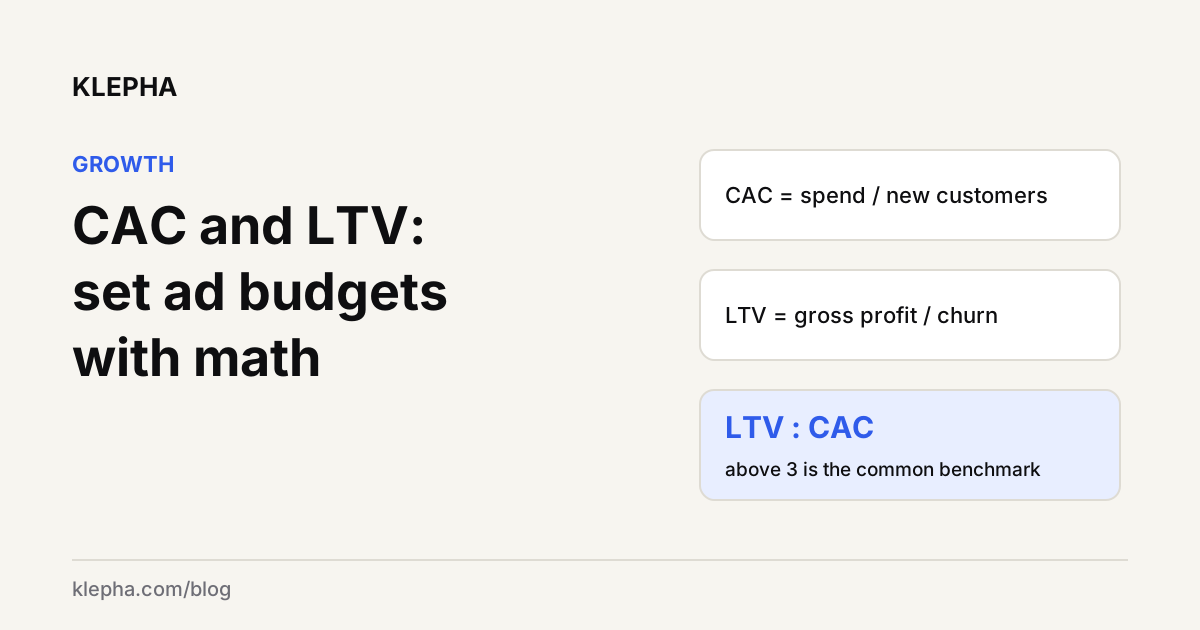
To calculate customer acquisition cost, divide everything you spent on sales and marketing in a period by the number of new customers you acquired in that period. To calculate customer lifetime value, take the gross profit an average customer generates per month and divide it by your monthly churn rate, or for one-off purchases multiply margin per order by the number of orders a customer places over their life. Comparing the two tells you whether growth pays for itself, and how much you can afford to bid for a customer.
The math is simple. The hard part is feeding it honest inputs. This guide gives you the formulas, two worked examples, the ratio benchmarks with their source, and a step-by-step method for turning them into ad budgets and bid limits.
Key takeaways
- CAC = sales and marketing costs in a period ÷ new customers in that period. Include people and tools, not just ad spend.
- LTV (subscriptions) = average revenue per account × gross margin ÷ churn rate. Use gross profit, not revenue.
- LTV:CAC above 3 is the widely quoted benchmark from David Skok's SaaS Metrics 2.0, which says the best SaaS businesses exceed 3.
- Payback period = CAC ÷ monthly gross profit per customer. It shows how long cash is tied up.
- Maximum CAC = LTV ÷ target ratio. Multiply by your click-to-customer rate to get a maximum CPC.
How do you calculate customer acquisition cost (CAC)?
The formula:
CAC = total sales and marketing costs in the period ÷ new customers acquired in the period"Costs" should include everything you spend to win new customers: ad spend, agency and freelancer fees, marketing and sales salaries (or the share of time spent on acquisition), sales commissions, software used for marketing and sales, content production, events and sponsorships. Excluding salaries and tools is the most common way CAC gets understated.
"New customers" means paying customers who started in the period, not leads, sign-ups or free trials. If you sell to businesses with long sales cycles, match spend to the customers it produced by shifting the spend window back by your typical cycle length, for example spend from one quarter against customers closed in the next.
Blended CAC versus paid CAC
Blended CAC divides all acquisition costs by all new customers, including those from organic search, referrals and word of mouth. Paid CAC divides paid media costs by the customers attributed to paid channels. Blended CAC tells you whether the business works. Paid CAC tells you whether a specific channel is worth more budget. Use both, and be explicit about which one you are quoting.
How do you calculate customer lifetime value (LTV)?
For subscription businesses, the standard simple formula is:
LTV = average revenue per account per month × gross margin % ÷ monthly churn rateDividing by churn estimates the average customer lifetime: at 4% monthly churn, the average customer stays about 1 ÷ 0.04 = 25 months. Multiplying by gross margin turns revenue into the profit you can actually spend on acquisition, which is why LTV should be based on gross profit rather than revenue.
For ecommerce and other repeat-purchase businesses without subscriptions:
LTV = average order value × gross margin % × purchases per year × expected years as a customerBase purchase frequency and lifespan on your own cohorts: take customers who first bought 12, 24 or 36 months ago and count what they actually spent since. If your business is too young for that, use a conservative estimate and label it as one.
What do the calculations look like in practice?
The two examples below use illustrative numbers to show the method. They are not benchmarks.
Example 1: a SaaS product
| Input | Value |
|---|---|
| Ad spend in the month | $20,000 |
| Marketing and sales salaries (acquisition share) | $8,000 |
| Marketing and sales tools | $2,000 |
| New paying customers in the month | 100 |
| Average revenue per account | $80 per month |
| Gross margin | 80% |
| Monthly churn | 4% |
- CAC = ($20,000 + $8,000 + $2,000) ÷ 100 = $300.
- Monthly gross profit per customer = $80 × 0.80 = $64.
- LTV = $64 ÷ 0.04 = $1,600.
- LTV:CAC = $1,600 ÷ $300 = 5.3.
- CAC payback = $300 ÷ $64 = 4.7 months.
If you had counted ad spend only, CAC would look like $200 and the ratio 8.0, a far rosier picture than reality.
Example 2: an ecommerce store
| Input | Value |
|---|---|
| Average order value | $60 |
| Gross margin (after product, shipping and payment costs) | 40% |
| Orders per customer per year | 2.5 |
| Expected years as a customer | 3 |
| Blended CAC | $45 |
- Gross profit per order = $60 × 0.40 = $24.
- LTV = $24 × 2.5 × 3 = $180.
- LTV:CAC = $180 ÷ $45 = 4.0.
- Payback: the first order returns $24, so CAC is recovered with the second order, roughly five months after the first purchase at 2.5 orders a year.
What is a good LTV to CAC ratio?
The most quoted benchmark comes from investor David Skok's "SaaS Metrics 2.0," which says "the best SaaS businesses have a LTV to CAC ratio that is higher than 3, sometimes as high as 7 or 8," and that many of the best "are able to recover their CAC in 5-7 months." It is a rule of thumb for subscription software, not a law, and it is a sensible starting point for most businesses.
| LTV:CAC | What it usually means | What to consider |
|---|---|---|
| Below 1 | Each customer loses money | Fix pricing, margin, retention or channel mix before scaling spend |
| 1 to 3 | Thin margin for overhead and error | Improve conversion and retention; scale cautiously |
| Around 3 or higher | Healthy by Skok's benchmark | Scale the channels that produce it, watching payback |
| Far above 5 | Possibly under-investing in growth | Test higher budgets, as long as cash flow allows |
Watch payback alongside the ratio. A 4:1 ratio with a 30-month payback can still run a young company out of cash, because the money comes back slowly.
Lower CAC with channels you do not pay per click for
Organic search and AI assistant mentions bring customers without a bid. A free Klepha report shows where you appear in Google, ChatGPT, Gemini and Perplexity today.
Get my free reportHow do you use LTV and CAC to set ad budgets?
Work backwards from what a customer is worth to what you can pay for a click. Channel-level CAC is only as good as your attribution, so tag campaigns with consistent UTM parameters and test changes with a proper A/B test before scaling them. Using the SaaS example and a target ratio of 3:
- Set the maximum CAC. Maximum CAC = LTV ÷ target ratio = $1,600 ÷ 3 = $533. Above that, new customers do not meet your bar.
- Set the channel's cost per acquisition limit. Paid channels also carry a share of salaries and tools. If ads must cover their share of overhead, set the ad-only target CPA below the full maximum, for example $400.
- Convert to a maximum cost per click. Measure your click-to-customer rate. If 2% of ad clicks start a trial and 25% of trials pay, then 0.5% of clicks become customers. Maximum CPC = $533 × 0.005 = $2.67, or $2.00 at the $400 ad-only target.
- Size the budget from the goal. To win 100 customers at a $400 CPA, plan about $40,000 of spend, then check that the payback period fits your cash.
- Scale by marginal CAC, not average CAC. As budgets rise, each extra customer usually costs more. Increase spend in steps and compare the CAC of the additional customers with your maximum.
- Review monthly with cohorts. Recalculate churn, margin and conversion rates. If LTV falls, the maximum CAC falls with it.
The landing page is a direct lever in step 3: doubling the click-to-customer rate doubles the CPC you can afford. Our guide to landing pages for paid ad traffic covers that side, and if you are weighing a newer channel, see how ChatGPT ads work.
How do CAC and LTV differ by channel?
Customers do not all cost or behave the same, so it pays to calculate both metrics per channel once you have enough customers in each. A few patterns are worth checking in your own data rather than assuming:
- Paid search and paid social have a cost on every click, so their CAC is easy to see and moves quickly with bids and competition.
- Organic search and AI assistant referrals carry content and SEO costs up front but no cost per click, so their CAC tends to fall as pages keep earning visits.
- Referrals and partnerships often bring customers who already trust you. Compare their churn with other channels before deciding what they are worth.
- Discount-led campaigns can lower CAC while also lowering LTV if those customers churn when the discount ends.
Channel-level LTV needs patience: you only know how a cohort retains after months of data. Until then, compare early signals such as second-purchase rate or month-two retention by channel. Two tools help here: an email welcome sequence raises the share of subscribers who become customers without new acquisition cost, and for paid search, Google's Customer Journey Insights card shows whether campaigns move people toward purchase before the conversions arrive.
What mistakes distort CAC and LTV?
- Revenue-based LTV. Using revenue instead of gross profit inflates LTV, sometimes several times over for low-margin businesses.
- Ad-only CAC presented as total CAC. Fine for channel comparisons, misleading for the business.
- Optimistic churn. Early cohorts often churn faster or slower than later ones. Recalculate as data arrives, and cap assumed lifetimes, for example at three to five years, until you have the history.
- Counting sign-ups as customers. Free users and trials are not customers until they pay.
- Ignoring organic channels. Search and referrals lower blended CAC. Cutting content or SEO can quietly raise it months later. Our guide to increasing organic traffic covers how to grow the low-CAC side.
- Mixing segments. Enterprise and self-serve customers have very different LTV and CAC. Calculate them separately.
Klepha helps teams build the organic and AI search channels that bring blended CAC down over time. Our Blog Ranking service, expertise page and case studies explain how.
Sources
- David Skok, For Entrepreneurs, "SaaS Metrics 2.0: A Guide to Measuring and Improving What Matters", first published January 16, 2013, updated June 18, 2026, accessed November 9, 2026. forentrepreneurs.com
- Klepha, worked examples in this article use illustrative inputs to demonstrate the formulas; they are not industry benchmarks.
Frequently asked questions
What is the formula for customer acquisition cost?
CAC equals total sales and marketing costs in a period divided by the number of new paying customers acquired in that period. Include ad spend, salaries or the acquisition share of them, agency fees, commissions and tools, not just media spend.
What is the formula for customer lifetime value?
For subscriptions, LTV equals average revenue per account per month multiplied by gross margin, divided by the monthly churn rate. For repeat-purchase businesses, multiply average order value by gross margin, purchases per year and expected years as a customer.
What is a good LTV to CAC ratio?
A ratio above 3 is the widely used benchmark. David Skok's SaaS Metrics 2.0 says the best SaaS businesses have an LTV to CAC ratio higher than 3, sometimes as high as 7 or 8. Below 1 means each customer loses money.
How do I calculate CAC payback period?
Divide CAC by the monthly gross profit an average customer generates. For example, a CAC of $300 and $64 of monthly gross profit per customer gives a payback period of about 4.7 months.
How do I use LTV and CAC to set a maximum cost per click?
Divide LTV by your target LTV to CAC ratio to get the maximum CAC, then multiply it by the share of ad clicks that become paying customers. With a $533 maximum CAC and a 0.5% click-to-customer rate, the maximum CPC is about $2.67.
Should LTV use revenue or profit?
Use gross profit. Acquisition has to be paid for out of what a customer leaves after the cost of serving them, so a revenue-based LTV overstates how much you can afford to spend to win a customer.