How do you write a landing page that converts paid ad traffic?
Every paid click has already cost you money before the page loads. The pages that earn it back do four simple things well: they keep the ad's promise, ask for one action, prove it honestly and load fast.
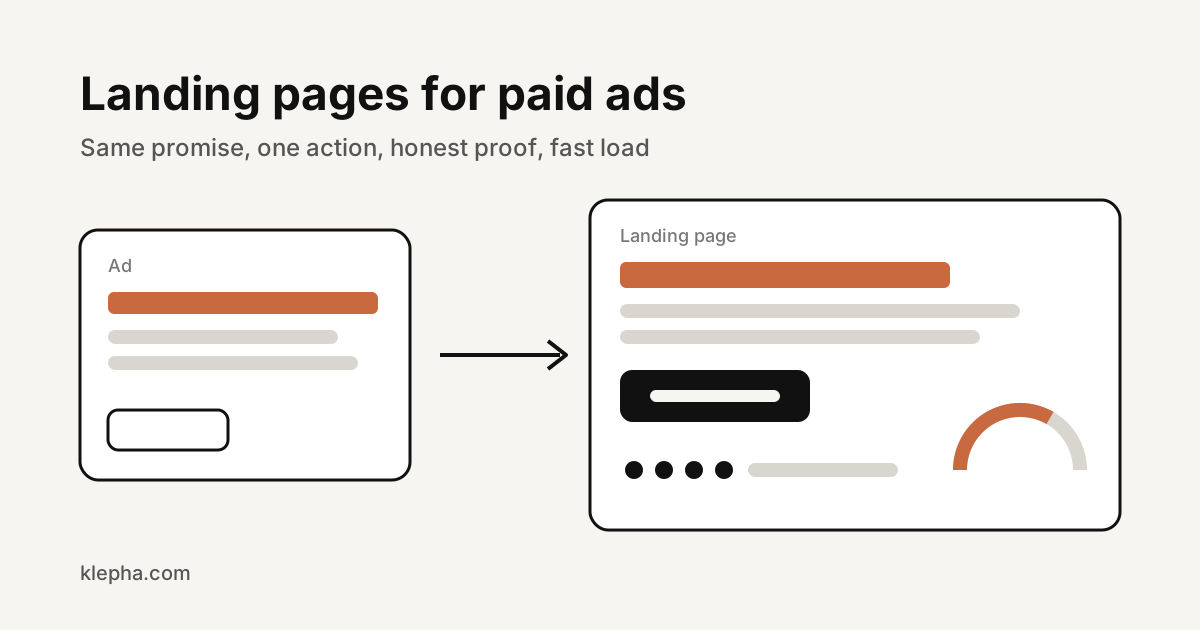
A landing page converts paid ad traffic when it repeats the exact promise the ad made, asks the visitor for one clear action, backs the promise with honest proof, and loads quickly on a phone. Google Ads Help puts the core of it plainly: people who click an ad expect a page relevant to what they saw, and if they do not immediately find it, they are more likely to leave.
None of this requires a redesign. Most paid landing pages fail on one of those four points, and each one can be checked in an afternoon. This guide walks through them with simple before and after examples, explains how Google and Meta look at your page, and ends with a checklist to run before you spend another dollar on clicks. Better conversion also raises the cost per click you can afford, which our guide to calculating CAC and LTV shows with worked numbers.
Key takeaways
- Message match comes first. Repeat the ad's headline, offer and terms on the page, in the same words.
- One page, one action. Every button should lead to the same next step, and the button should say what that step is.
- Proof must be real. Fake or AI-generated reviews are banned under the FTC's 2024 rule, and "results not typical" does not fix a misleading testimonial.
- Speed is measurable. Aim for LCP within 2.5 seconds, INP of 200 ms or less and CLS of 0.1 or less at the 75th percentile.
- Landing page experience is one of three Quality Score components in Google Ads, and Meta only counts a landing page view once the page actually loads.
What decides whether a paid click converts?
Organic visitors often arrive curious and willing to browse. Paid visitors arrive with a specific expectation that you created, in an ad you wrote, a few seconds earlier. The landing page has one job: confirm that expectation and make the next step obvious.
That gives you four questions the page has to answer almost instantly:
| Visitor's question | What answers it | Section |
|---|---|---|
| Am I in the right place? | Message match between ad and page | Message match |
| What do I do now? | One clear call to action | One call to action |
| Can I trust this? | Honest, specific social proof | Social proof |
| Will this waste my time? | A page that loads and responds quickly | Page speed |
Most of the on-page fundamentals in our on-page SEO checklist still apply, since a clear headline, scannable structure and fast images help any page. The difference with paid traffic is that you know exactly what the visitor was promised, so you can be far more specific.
What is message match, and how do you get it right?
Message match means the landing page repeats the promise of the ad that sent the visitor there: the same offer, the same wording for the key benefit, the same price or terms. Google Ads Help gives a direct example. If your keyword is "discount shoes" and your ad promises shoes at 20% off, customers should be able to find and buy shoes at that discounted price on the landing page. It also advises that the page mirror the ad's call to action, so an ad that invites people to sign up for a free tour should lead to a page with a prominent sign-up form.
A simple before and after (illustrative example)
The example below is invented to show the principle. It is not a client case and the business is fictional.
| Element | Before | After |
|---|---|---|
| Ad headline | Same-day boiler repair, fixed price | Same-day boiler repair, fixed price |
| Landing page | Homepage | Dedicated boiler repair page |
| Page headline | Welcome to Northside Heating, your trusted local experts | Same-day boiler repair at a fixed price |
| Price | "Contact us for a quote" at the bottom | The fixed call-out price and what it includes, under the headline |
| Call to action | Six menu links plus "Learn more" | "Book a same-day visit" button and a tap-to-call number |
The "after" page is not cleverer. It simply stops making the visitor search for the thing they clicked on.
How to build message match into your account
- One theme per ad group, one page per theme. Google Ads Help recommends grouping keywords by theme or product so each ad can be tailored to that theme. The landing page should follow the same grouping.
- Copy the ad's words into the headline. If the ad says "fixed price", the headline says "fixed price", not "transparent pricing".
- Put the offer above the fold. Google advises placing important information towards the top so people do not have to scroll to see it.
- Match the audience as well as the words. A Meta ad aimed at first-time buyers and a search ad for an exact model number deserve different pages, even for the same product.
Why should a landing page have one clear call to action?
A call to action is the single thing you want the visitor to do next: book, buy, call, start a trial or request a quote. Each extra choice is another way to leave without doing it. Google Ads Help asks advertisers to make it quick and easy for customers to take the action you want, not to make them hunt for information, and to avoid cluttering the page with too many ads or pop-ups.
One call to action does not mean one button. A long page can repeat the same button several times. It means every button leads to the same next step.
Before and after (illustrative example)
| Element | Before | After |
|---|---|---|
| Primary buttons | "Start free trial", "Book a demo", "See pricing", "Read the blog" | "Start your 14-day trial" repeated after each section |
| Button text | "Submit" | "Start my trial", which says what happens on click |
| Form | Nine fields, including company size and budget | Name, work email, password |
| Navigation | Full site menu | Logo and the trial button only |
The trial length in this example is fictional. Use whatever your ad actually offers, and only promise what the page delivers.
Practical rules for the call to action
- Mirror the ad. Google notes that the more specific your call to action, the closer it matches your keywords and landing page, the better your chances of a conversion.
- Name the outcome on the button. "Get my quote" tells the visitor what they will receive. "Submit" does not.
- Ask only for what you will use. If sales never reads the "budget" field on the first call, remove it.
- Make contact easy on mobile. Google's mobile advice is short: keep it quick, make it easy to contact you and use simple navigation. A tap-to-call link is often the right secondary path for local services.
What social proof can you honestly use?
Social proof answers the visitor's quiet question: did this work for people like me? Google Ads Help suggests adding reviews that show real opinions from other customers as part of useful, original landing page content. The word that matters is "real".
In the United States, the FTC's Trade Regulation Rule on the Use of Consumer Reviews and Testimonials (16 CFR Part 465) was published on August 22, 2024 and took effect on October 21, 2024. According to the FTC's announcement, it prohibits businesses from creating or selling reviews and testimonials that misrepresent who wrote them or what their experience was, explicitly including AI-generated fake reviews, and from buying such reviews. The rule also covers paying for reviews that must express a particular sentiment and misrepresenting displayed reviews as complete when negative ones are being suppressed. The FTC can seek civil penalties against knowing violators.
The FTC's Endorsement Guides, revised in 2023, add two points that matter on landing pages. First, a testimonial that claims a specific result will usually be read as what others can expect, and statements such as "Results not typical" or "Individual results may vary" do not change that. You either need proof the result is typical, or you must clearly disclose the generally expected result. Second, if a reviewer received something in return, such as a free product, payment or a discount, that connection should be disclosed when it could affect how readers weigh the review.
Honest proof is also a matter of values at Klepha. We would rather a client show three real, modest reviews than thirty perfect invented ones, and the law now says the same thing.
Before and after (illustrative example)
| Element | Before | After |
|---|---|---|
| Testimonial | "Best service ever!!" by "Sarah K." with a stock photo | A specific quote from a named customer who agreed to be featured, with the job type and month |
| Results claim | "Customers cut their bills by 60%" with "results may vary" | The average result across customers, with how it was measured, or no number at all |
| Ratings | "5 stars" with no source | A rating with its platform and review count, linking to where it can be checked |
| Incentives | Reviews gathered with a discount, not mentioned | A short note that reviewers received a discount for leaving a review of any rating |
Proof that does not depend on reviews
- Specific guarantees you will honor, such as a clear refund window, stated in plain terms.
- Credentials you can verify, such as licences, certifications or memberships, named exactly.
- Transparent details: a real address, a phone number, named staff and a visible privacy policy.
- Real work: screenshots or photos of your own product or projects, labeled honestly. Our case studies show how we present client results with context.
Check how your pages show up in search and AI answers
A free Klepha report scans your site and shows where your pages appear in Google and AI assistants, so the people who do not click an ad can still find you.
Get my free reportHow fast does a paid landing page need to be?
Fast enough that nobody leaves while it loads. Google's Core Web Vitals give you concrete targets. According to web.dev (last updated October 31, 2024), a good experience means:
| Metric | What it measures | Good threshold |
|---|---|---|
| Largest Contentful Paint (LCP) | Loading: when the main content appears | Within 2.5 seconds |
| Interaction to Next Paint (INP) | Responsiveness to taps and clicks | 200 milliseconds or less |
| Cumulative Layout Shift (CLS) | Visual stability while loading | 0.1 or less |
web.dev recommends measuring at the 75th percentile of page loads, segmented by mobile and desktop, and treats a page as passing only when all three metrics meet the target. Field data from real visitors is the source of truth; lab tools such as Lighthouse are for diagnosing why.
Speed matters on Meta too, in a very literal way. Meta defines a landing page view as a person clicking your ad link and then successfully loading the destination page. If someone taps and gives up before the page loads, you paid for the click but did not get the view.
Before and after (illustrative example)
| Element | Before | After |
|---|---|---|
| Hero | Autoplay background video | One compressed image with width and height set |
| Scripts | Chat widget, heatmap, two pixels and a carousel library | The tracking you actually report on, loaded after the main content |
| Fonts | Four font families | One family, two weights |
| Layout | Cookie banner and promo bar push the headline down | Space reserved so nothing shifts after the page appears |
Our technical SEO audit guide covers how to find and fix the usual causes of slow LCP and layout shift in more depth.
How do Google Ads and Meta judge your landing page?
Both platforms look at what happens after the click, though in different ways.
Google Ads: landing page experience and Quality Score
Google Ads Help describes Quality Score as a diagnostic tool, measured from 1 to 10 at the keyword level, that compares your ad quality with other advertisers. It combines three components: expected clickthrough rate, ad relevance and landing page experience, which Google defines as how relevant and useful your landing page is to people who click your ad. Each component is rated "Above average", "Average" or "Below average" against other advertisers whose ads showed for the exact same search over the last 90 days.
Two details are worth knowing. Google states that Quality Score is not a key performance indicator and is not an input in the ad auction; it is a way to spot where ads, pages or keywords could improve. And Google notes that information from its crawlers may be used to assess ad quality, so make sure the page is accessible to Google's crawlers and shows its main content in the HTML. If your landing page experience reads "Below average", start with message match and speed before anything else.
Meta: landing page views
When you optimize a Meta ad set for landing page views, Meta says it tries to show the ad to people most likely to click and fully load your website. For conversion goals, Meta's guidance notes that a conversion-optimized ad set needs about 50 or more of the optimized conversion per week to have a chance at being effective, and suggests landing page view optimization as an alternative when you are below that. Either way, a page that loads slowly or loses people on arrival gives the system less to learn from.
Pre-launch checklist for a paid landing page
Run these eight checks every time you launch a new page or point a new campaign at an existing one.
- Read the ad and the page side by side. Confirm the headline repeats the ad's main promise in the same words and the offer, price and terms in the ad are visible on the page without scrolling.
- Count the actions. There should be one primary call to action. Every button on the page should lead to the same action, and the button text should say what happens next.
- Trim the form. Remove every field you will not use in the first conversation with the lead.
- Audit every piece of proof. Each review, quote, logo or number must be real, attributable, current and permitted, with any incentive or connection disclosed and no implied typical result you cannot support.
- Test speed on a phone. Check field data in PageSpeed Insights where available and aim for LCP of 2.5 seconds or less, INP of 200 milliseconds or less and CLS of 0.1 or less at the 75th percentile.
- Check transparency. Make sure the business name, contact details, pricing terms and privacy policy are easy to find.
- Fire a test conversion. Submit the form or complete the purchase yourself and confirm the conversion is recorded in Google Ads, Meta Ads Manager and your analytics.
- Decide what you will measure. Write down the one metric this page is judged on and the date you will review it, before the first click arrives.
How should you test and improve the page after launch?
You will not find industry conversion-rate benchmarks in this guide, because published averages vary widely by source, sector, offer and how a "conversion" is counted. Your own baseline is the only comparison that means anything. Record it for the first few weeks, then change one thing at a time.
- Test the biggest lever first. Headline and offer changes usually matter more than button colors.
- Give each test enough traffic. Small samples swing wildly, so calculate the sample you need before you start and wait for it. Our guide to A/B testing ads and landing pages shows how.
- Tag every traffic source. Use consistent UTM parameters on non-Google campaigns so each landing page variant is credited to the right channel.
- Watch quality, not only volume. A shorter form may raise sign-ups and lower the share that become customers. Judge the page on the outcome you care about.
- Keep organic in view. Some paid visitors come back later through search. Pages written with the principles in our guide on how to optimize content for search engines help those visitors find you again without another paid click.
If you want help connecting paid landing pages with the rest of your search presence, our Blog Ranking service and team expertise cover the organic side, and the solutions overview shows how the pieces fit. No page, paid or organic, comes with guaranteed results; the aim is to remove the reasons people leave.
A landing page only works inside a sensible account. If you are starting with limited spend, see how to structure a Google Ads account on a small budget, and keep in mind that AI Mode searches show up only as approximations in your search terms report, so match pages to intent, not just to the visible keyword.
Sources
- Google Ads Help, "About Quality Score for Search campaigns", retrieved November 8, 2026. Quality Score scale, its three components, the 90-day comparison and its status as a diagnostic that is not an auction input. support.google.com/google-ads/answer/6167118
- Google Ads Help, "Optimize your ads and landing pages", retrieved November 8, 2026. Matching the page to the ad and keywords, the discount shoes example, mirroring the call to action, mobile, navigation and real customer reviews. support.google.com/google-ads/answer/6238826
- web.dev (Google), Philip Walton, "Web Vitals", last updated October 31, 2024. Core Web Vitals thresholds for LCP, INP and CLS and the 75th percentile guidance. web.dev/articles/vitals
- Meta Business Help Center, "About landing page view optimization", retrieved November 8, 2026. Definition of a landing page view. facebook.com/business/help/417293491972212
- Meta Business Help Center, "Best practices for landing page view performance goals", retrieved November 8, 2026. Guidance on about 50 conversions per week for conversion optimization. facebook.com/business/help/203012060587398
- Federal Trade Commission, "Federal Trade Commission Announces Final Rule Banning Fake Reviews and Testimonials", August 2024. ftc.gov press release
- eCFR, 16 CFR Part 465, "Rule on the Use of Consumer Reviews and Testimonials", source 89 FR 68077, August 22, 2024, effective October 21, 2024. ecfr.gov/current/title-16/part-465
- Federal Trade Commission, "FTC's Endorsement Guides: What People Are Asking", reflecting the Endorsement Guides as revised in 2023, retrieved November 8, 2026. Typical results and disclosure of material connections. ftc.gov business guidance
Frequently asked questions
What makes a landing page convert paid ad traffic?
Four things do most of the work. The page repeats the promise the ad made, it asks for one clear action, it shows honest proof that others got what you promise, and it loads quickly on a phone. Everything else is refinement on top of those four.
Should I send paid traffic to my homepage?
Usually not. A homepage is built to serve every visitor, so it rarely repeats the specific promise of one ad. Google Ads Help advises choosing a landing page that closely matches your ad and keywords. A dedicated page per offer or ad group makes that match far easier.
Does landing page experience affect Quality Score?
Yes. Google Ads Help lists landing page experience as one of three Quality Score components, alongside expected clickthrough rate and ad relevance. Google also states that Quality Score itself is a diagnostic tool and is not an input in the ad auction, so treat it as a symptom to investigate rather than a number to chase.
How fast should a paid landing page load?
Use Google's Core Web Vitals as the target: Largest Contentful Paint within 2.5 seconds, Interaction to Next Paint of 200 milliseconds or less and Cumulative Layout Shift of 0.1 or less, measured at the 75th percentile of real page loads, split by mobile and desktop.
Can I use testimonials and reviews on a landing page?
Yes, if they are real and fairly presented. In the US, the FTC rule on consumer reviews and testimonials, effective October 21, 2024, bans fake or AI-generated reviews and testimonials, and the FTC Endorsement Guides require you to disclose material connections and avoid implying that exceptional results are typical.
Is a good landing page guaranteed to lower my cost per conversion?
No. A better page removes reasons to leave, but results also depend on the offer, the audience, the bid strategy and the competition in each auction. Test one change at a time and judge it on your own conversion data.