What did Google's 2026 core updates change, and how do you recover?
Google has released three core updates in 2026: March, May and the November 2026 core update, which began rolling out on November 10 and may take up to two weeks. Here are the verified dates, how to track impact while November rolls out, what the sites that gained or lost in March and May had in common according to named analyses, and a recovery checklist taken from Google's own guidance.
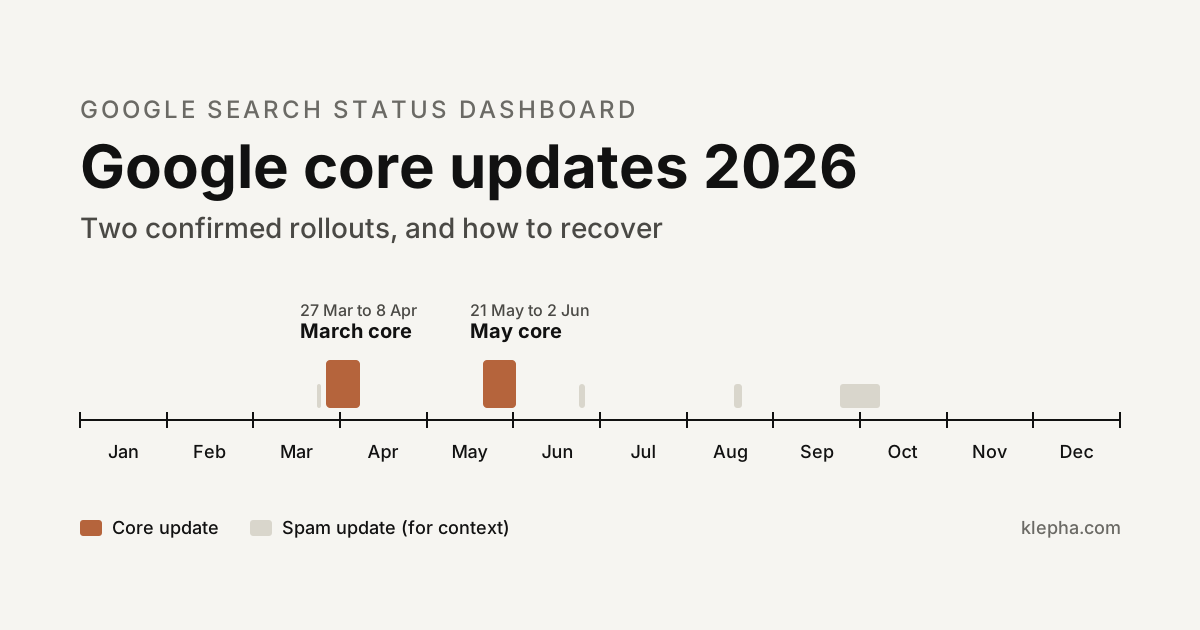
Google has released three core updates in 2026: the March 2026 core update (March 27 to April 8), the May 2026 core update (May 21 to June 2) and the November 2026 core update, which started on November 10 at 10:06 Pacific time and was still rolling out when we checked the Google Search Status Dashboard on November 11. Google says the November rollout may take up to two weeks and applies globally to all languages.
Google did not say what any of the three updates targeted. What we know about winners and losers comes from third-party visibility data, which is useful but correlational. The recovery advice below is Google's own, quoted from Search Central, with the analyst findings layered on top and labelled as such.
Key takeaways
- Three core updates in 2026: March (27 March to 8 April), May (21 May to 2 June) and November (started 10 November, up to two weeks), per Google's dashboard.
- During the November rollout, annotate the start date, watch but do not act, and analyze only a full week after Google marks it complete.
- March, per Amsive and Sistrix: visibility tilted toward official, brand-owned and government sites and away from aggregators, user-generated content and content made mainly for search.
- May, per Aleyda Solis and Sistrix: visibility moved toward the source type that best fits each query's intent and market; some March losers recovered.
- These are observed correlations, not Google statements. Google says core updates do not target specific sites.
- Recovery follows Google's self-assessment, not quick fixes, and can take months or the next core update.
Which core updates did Google release in 2026?
The Google Search Status Dashboard is the authoritative record, and Google's own core updates page points to it for announcements. The table below lists every ranking incident the dashboard shows for 2026, verified on November 8, 2026 and updated on November 11, 2026. Times are US Pacific, as the dashboard reports them.
| Update | Type | Started | Completed | Duration |
|---|---|---|---|---|
| February 2026 Discover update | Discover only (US, English) | Feb 5 | Feb 27 | 21 days, 17 hours |
| March 2026 spam update | Spam | Mar 24 | Mar 25 | 19 hours, 30 minutes |
| March 2026 core update | Core | Mar 27, 02:00 | Apr 8, 06:00 | 12 days, 4 hours |
| May 2026 core update | Core | May 21, 08:40 | Jun 2, 05:40 | 11 days, 21 hours |
| June 2026 spam update | Spam | Jun 24 | Jun 26 | 2 days, 1 hour |
| August 2026 spam update | Spam | Aug 18 | Aug 21 | 2 days, 16 hours |
| September 2026 spam update | Spam | Sep 24 | Oct 8 | 13 days, 16 hours |
| November 2026 core update | Core | Nov 10, 10:06 | Still rolling out on Nov 11 | Up to 2 weeks, per Google |
Three details matter for anyone diagnosing a drop. First, the March spam update finished on March 25, two days before the March core update began, so a decline that starts on March 24 or 25 is more likely tied to spam systems than to the core update. Second, the February update's announcement described it as a Discover core update for English-language users in the US, so it affects Discover traffic rather than web search rankings. Third, the previous broad core update, December 2025, ran from December 11 to December 29, 2025, which means the March update arrived about three months later.
You may see articles describing January or June 2026 core updates. Google's incident history lists neither. The only June ranking incident is a spam update. The September spam update, the longest spam rollout of the year, has its own September 2026 spam update guide with a diagnosis routine.
What is the November 2026 core update?
The November 2026 core update is Google's third broad core update of 2026. Google's Search Status Dashboard lists it as an active ranking incident that started on November 10, 2026 at 10:06 Pacific time, and states that it "applies globally and to all languages" and that "the rollout may take up to 2 weeks to complete." In its LinkedIn announcement Google called it "a regular update designed to better surface relevant, satisfying content for searchers from all types of sites."
Google did not publish new guidance for this update. Search Engine Land noted that the advice from previous updates still applies: there may be no specific action to take, a ranking drop does not necessarily mean something is wrong with your pages, and the biggest recoveries tend to come with a later core update. It arrived about five months after the May update completed on June 2.
What does a core update change?
A core update is a broad change to Google's ranking systems, not a penalty and not a rule aimed at particular sites. Google's documentation says core updates "don't target specific sites or individual web pages" and compares the effect to revising a list of favorite restaurants: some move down because others have become better choices, not because they got worse. That is different from a spam update, which targets specific policy violations, or a manual action, which appears in Search Console. If you see a manual action notice, you are dealing with something else.
| Change type | What it targets | Where it shows | What to do |
|---|---|---|---|
| Core update | Broad reassessment of relevance and quality across the web | Search Status Dashboard | Wait for completion, then assess the site as a whole |
| Spam update | Sites violating spam policies | Search Status Dashboard | Review spam policies; see our spam update guide |
| Manual action | One site, after human review | Search Console Manual actions report | Fix the issue and request reconsideration |
How do you track impact during the two week rollout?
Track it, but do not judge it yet. Google recommends confirming the rollout has finished and then waiting "at least a full week" before analyzing Search Console, and SISTRIX's May data showed changes arriving in two separate waves days apart. A practical routine for November:
- Annotate November 10 in your analytics and reporting tools so nobody misreads the next few weeks.
- Save a baseline now. Export Search Console performance for November 3 to 9, the week before the rollout, by page and by query. Search Engine Roundtable reported unconfirmed ranking volatility around November 8 and 9, so also keep October 20 to 26 as a second reference week.
- Watch daily, in aggregate. Check total clicks and impressions for your top page groups and your money queries. Note the days movement starts and stops, but make no changes based on it.
- Separate search types and devices. Compare Web, Images, Video and News, and mobile versus desktop, so you know where any movement sits.
- Rule out other causes as you go. Check for tracking changes, deployments, indexing errors and seasonality, which our guide to why website traffic drops walks through.
- Wait for the dashboard to show completion, then a full week, then compare that week with November 3 to 9 by page and query.
Also check AI visibility separately. Core updates change the pages Google ranks, and AI Overviews and AI Mode draw on those results, so a ranking shift can change which sources are cited in AI answers too. Tracking which of your pages Google's AI features cite, before and after the rollout, helps you see whether a traffic change came from rankings or from AI answers; our guide to ranking in Google AI Overviews explains what drives those citations.
What should you not do during a core update rollout?
- Do not make "quick fix" changes such as removing page elements you heard were bad for SEO. Google advises against them.
- Do not rewrite or delete pages mid-rollout. You will not be able to tell whether the update or your change caused what follows, and Google calls deleting content a last resort.
- Do not refresh dates on pages that have not substantially changed; Google lists that among signs of search-first content.
- Do not trust early winner and loser lists. Visibility tools publish within days, but movement in March and May reversed for some domains between updates.
- Do not change several things at once after the update either. Make improvements in batches you can measure.
What did sites that lost or gained in March 2026 have in common?
Two named, dated analyses describe the March update. Both use SISTRIX visibility data, which estimates rankings across a fixed keyword set rather than measuring real traffic.
Amsive: an official-source correction
Lily Ray's analysis for Amsive, published April 30, 2026, examined the 500 biggest percentage and absolute winners and losers in SISTRIX data. She described March as "a first-party, official-source correction," with visibility tilting toward authoritative, brand-owned and government domains and away from user-generated content, comparison aggregators and content built primarily for search visibility. YouTube showed the largest visibility loss, with broad declines across social, aggregator and reference categories.
Her category breakdown follows the same line. In travel, TripAdvisor, Yelp and Expedia fell while NPS.gov and Hilton rose. In jobs, Indeed and ZipRecruiter fell while BLS.gov and USAJobs.gov rose. In finance, NerdWallet fell while StudentAid.gov rose. Ray's conclusion was that comparison sites, travel agencies, job boards and review aggregators face shrinking moats, and that the answer is a stronger product rather than better SEO.
SISTRIX Germany: four losers for every winner
SISTRIX's German analysis, reported by Matt G. Southern in Search Engine Journal on April 10, 2026, counted 134 domains with confirmed visibility losses and 32 with gains. Online shops made up the largest share of losers, 39 of the 134, along with language tools and recipe portals. The 32 winners were dominated by official websites and established brands, including government sites and four German airport websites that rose together.
What did sites that lost or gained in May 2026 have in common?
May is better documented, and the most useful finding is that it did not simply repeat March.
Aleyda Solis: an intent-destination reset
Aleyda Solis published an analysis on June 3, 2026, based on SISTRIX US and UK data measured from May 26 to June 2. Her central pattern: visibility shifted toward the source type that best fit each query's intent, market and expected result format. She called it "an intent-destination reset."
- Reference: canonical reference brands gained (aggregated +24% UK, +10% US) while reference aggregators and tools fell (-29% UK, -13% US).
- Forums and Q&A: forum, Q&A and open publishing surfaces declined (-24% UK, -12% US), including Reddit, Quora and StackExchange, while large social, video and visual platforms were flat to positive.
- Local market fit: in the UK index, local-market retail domains rose about 20% while US .com marketplaces fell about 55%.
- Task destinations: category-defining jobs and travel marketplaces gained (+21% UK, +17% US). Indeed, Expedia and Trip.com were among them.
- Health: results split by source confidence and result fit, not by vertical.
Note the reversal. Indeed and Expedia lost in Amsive's March data and gained in Solis's May data. Solis's reading is that some March losers recovered when they were the place users actually complete a task, while derivative layers that summarize other sites stayed exposed.
SISTRIX: news media down, ecommerce flat
SISTRIX's own May tracking page, by Steve Paine (published May 26, updated June 5, 2026), found that 451 UK ecommerce domains showed very little impact, while 77 UK news media domains showed a strong net negative result. It also observed two clusters of change in US data, one starting a day or two into the rollout and another nearly a week later, which is a reminder not to judge an update mid-rollout.
Raptive: what resilient publishers shared
Raptive, an ad management company for publishers, analyzed more than 4,000 sites and 32 billion Google pageviews and published its findings on June 26, 2026. It reported that 70% of sites improved or maintained performance through the May rollout, and that lower ad density, stronger authority signals, fresher content, better page experience, more diversified audience signals and more complete content appeared repeatedly among resilient sites. Lower ad density was, in its words, one of the clearest site-level signals. Treat this as evidence about ad-supported content publishers, since that is the network Raptive studied.
Which patterns repeat across both updates?
Put the analyses side by side and a few correlations hold across both updates. None of these is a Google statement, and correlation in visibility data is not proof of what a ranking system rewards.
| Observed pattern | March 2026 evidence | May 2026 evidence |
|---|---|---|
| Originators beat intermediaries | Official, brand and government domains gained (Amsive; SISTRIX Germany) | Canonical reference brands gained; derivative tools fell (Solis) |
| Being the task destination matters | Aggregators and job boards lost (Amsive) | Category-defining jobs and travel marketplaces recovered (Solis) |
| Forum and UGC visibility is volatile | YouTube, Reddit and other UGC fell (Amsive) | Reddit, Quora, StackExchange fell; video and visual mixed to positive (Solis) |
| Market and format fit | Not a headline finding | Local-market retail favored in the UK (Solis); UK news media net negative (SISTRIX) |
The thread through all four rows is the question Solis poses directly: for this query, in this market, in this format, is your page the best default destination? A well-written page that summarizes other sources was the most exposed type in both updates. That matches Google's own self-assessment, which asks whether content avoids "simply copying or rewriting" other sources and instead adds "substantial additional value and originality."
What does Google say to do after a core update?
Google's page "Google Search's core updates and your website" is the primary source here, and it is more cautious than most commentary. Its key points:
- Core updates are broad. They "don't target specific sites or individual web pages." Google compares it to revising a top-20 restaurant list: places that move down "aren't necessarily bad," others simply moved up.
- Most sites need do nothing. Google says most sites "may not even realize one has happened."
- Wait for completion, then a week. Confirm the rollout has finished, wait "at least a full week," and compare against a week before the rollout started.
- Size the drop. A small drop, such as position 2 to 4, needs no drastic action. A large drop, such as position 4 to 29, warrants a deeper assessment.
- Assess the whole site. For a sustained large drop, use the helpful content self-assessment on the site as a whole, and focus on the most impacted pages.
See where your visibility actually moved
A free Klepha report shows how your pages perform in Google and which AI assistants mention you, so you can separate a core update from other causes.
Get my free reportA core update recovery checklist based on Google's guidance
Steps one to ten come straight from Google's core updates page and its helpful content self-assessment. Step eleven is drawn from the third-party patterns above and is labelled as such.
- Confirm the dates. Check the dashboard and note the exact start and end of the update. Use the table above for 2026; for November, wait until the dashboard marks the update complete.
- Compare the right weeks. Wait a full week after completion, then compare with a week before the start. For May 2026, compare a week from June 9 onward with May 14 to May 20. For November 2026, compare the first full week starting seven days after completion with November 3 to 9. For March, our suggestion is a pre-period of March 17 to 23, which avoids the March 24 spam update.
- Rule out other causes. Tracking breaks, migrations, indexing faults and AI Overviews can all look like an update. Our guide to why website traffic drops walks through that diagnosis, and a technical SEO audit covers the crawl and index side.
- Review top pages and queries. Classify each drop as small or large. Leave pages that slipped slightly alone; Google recommends avoiding changes to content that is already performing well.
- Separate search types. Analyze Web, Images, Video and News separately in Search Console to see where the loss happened.
- Run the content and quality questions. Does each impacted page provide original information, research or analysis? Does it offer substantial value compared with other pages in the results? Does the title describe the content without exaggerating?
- Run the expertise questions. Is sourcing clear? Is there background on the author or site? Is it written or reviewed by someone who demonstrably knows the topic? Are there easily verified factual errors?
- Answer Who, How and Why. Add accurate bylines that lead to author information. If automation substantially generated content, disclose how. Make sure the reason the page exists is to help people, not to attract search visits.
- Check the warning signs. Google lists producing lots of content on many topics hoping some performs, extensive automation, mainly summarizing others, changing dates without substantial changes, and writing to a word count as signs to reevaluate.
- Check page experience as a whole, not one or two metrics, and ask someone unaffiliated with your site to assess it honestly.
- Ask the source-type question (analyst view). For each lost query cluster, look at what now ranks. If the results favor official sources, task-completing tools or local-market pages, decide whether your page can genuinely be that type, as Aleyda Solis suggests.
For prioritizing which pages to work on first, our guide to finding pages that need SEO improvement sets out a triage order. If you want help applying this to a large site, our Blog Ranking service and SEO expertise page explain how we work, and our case studies show past results without promising any particular outcome.
How long does core update recovery take?
Google is explicit that it can be slow. Some changes "can take effect in a few days," but it "could take several months" for its systems to confirm that a site as a whole is producing helpful, reliable, people-first content. If several months pass without effect, Google says that "could mean waiting until the next core update."
There is a second path. Google says it makes smaller, unannounced core updates continually, and that these can also lift a site that has improved. So recovery does not strictly depend on the next named update.
For planning, the cadence helps. Google listed three core updates in 2025 (March, June and December) and three in 2026 (March, May and November). The November update began on November 10, 2026, a little over five months after the May update completed.
What should you avoid after a core update?
Google names several mistakes directly. Avoid "quick fix" changes, such as removing a page element because you heard it was bad for SEO. Treat deleting content as a last resort; Google notes that if you are considering deleting whole sections, those sections were likely made for search engines first. Do not refresh dates on pages that have not substantially changed, and do not add or remove large amounts of content just to look fresh, since Google says that will not help.
Also avoid reading too much into lists published during a rollout. The SISTRIX May data showed changes arriving in two waves, and the same domains moved in opposite directions between March and May. Diagnose your own pages against the dates, then improve them for readers. Ranking first is still the result of being the best answer for the query, which our playbook on how to rank number one on Google covers step by step.
Sources
- Google Search Status Dashboard, "All incidents reported for Ranking" and incident pages for the March 2026, May 2026 and November 2026 core updates, accessed November 8 and November 11, 2026. status.search.google.com
- Google Search Central, "Google Search's core updates and your website", last updated December 10, 2025, accessed November 11, 2026. developers.google.com
- Google Search Central, "Creating helpful, reliable, people-first content", last updated October 5, 2026, accessed November 8, 2026. developers.google.com
- Search Engine Land (Barry Schwartz), "Google November 2026 core update rolling out now", November 10, 2026, quoting Google's LinkedIn announcement. searchengineland.com
- Search Engine Roundtable, "Daily Search Forum Recap: November 9, 2026", on unconfirmed ranking volatility around November 8 and 9. seroundtable.com
- Amsive (Lily Ray), "Google March 2026 Core Update: Winners, Losers and Analysis", April 30, 2026. amsive.com
- Search Engine Journal (Matt G. Southern), "Google March Core Update Left 4 Losers For Every Winner In Germany", April 10, 2026, reporting SISTRIX data. searchenginejournal.com
- SISTRIX (Steve Paine), "May 2026 Core Update: Visibility Analysis and Data Updates", May 26, 2026, updated June 5, 2026. sistrix.com
- Aleyda Solis, "Google May 2026 Core Update Analysis: Intent, Market Fit and Source Type Drove the Biggest Visibility Shifts", June 3, 2026. aleydasolis.com
- Raptive, "What data from 4,000 sites revealed about Google's May 2026 core update", June 26, 2026. raptive.com
Frequently asked questions
When were the Google core updates in 2026?
Google's Search Status Dashboard lists three core updates in 2026. The March 2026 core update ran from March 27 to April 8, the May 2026 core update ran from May 21 to June 2, and the November 2026 core update began on November 10 and may take up to two weeks to complete.
Was there a June 2026 core update?
No. The dashboard lists a June 2026 spam update that ran from June 24 to June 26, not a core update. Some third-party articles refer to January or June 2026 core updates, but Google's own incident history does not list them.
What is the November 2026 core update?
It is Google's third core update of 2026, released on November 10, 2026. Google says it applies globally and to all languages, may take up to two weeks to roll out, and is a regular update to surface relevant, satisfying content. Google did not say what it targeted.
When should I analyze my traffic after a core update?
Google recommends waiting at least a full week after a core update finishes, then comparing that week with a week before the rollout started. For the November 2026 update, keep November 3 to 9 as the comparison week and wait until Google marks the rollout complete.
How long does it take to recover from a core update?
Google says some improvements can take effect in a few days, but it can take several months for its systems to confirm a site is producing helpful, reliable content over the long term. If several months pass without effect, Google says that could mean waiting until the next core update.
Should I delete content after a core update?
Google calls deleting content a last resort, to be considered only when content cannot be salvaged. It recommends meaningful improvements instead of quick fixes, and notes that if you are considering deleting whole sections, those sections were likely created for search engines first.