What is the difference between SEO, GEO and ASO?
Three acronyms, three places people look for answers: search results, AI assistants and app stores. Here is what each one optimizes for, who actually needs it, and where the work overlaps.
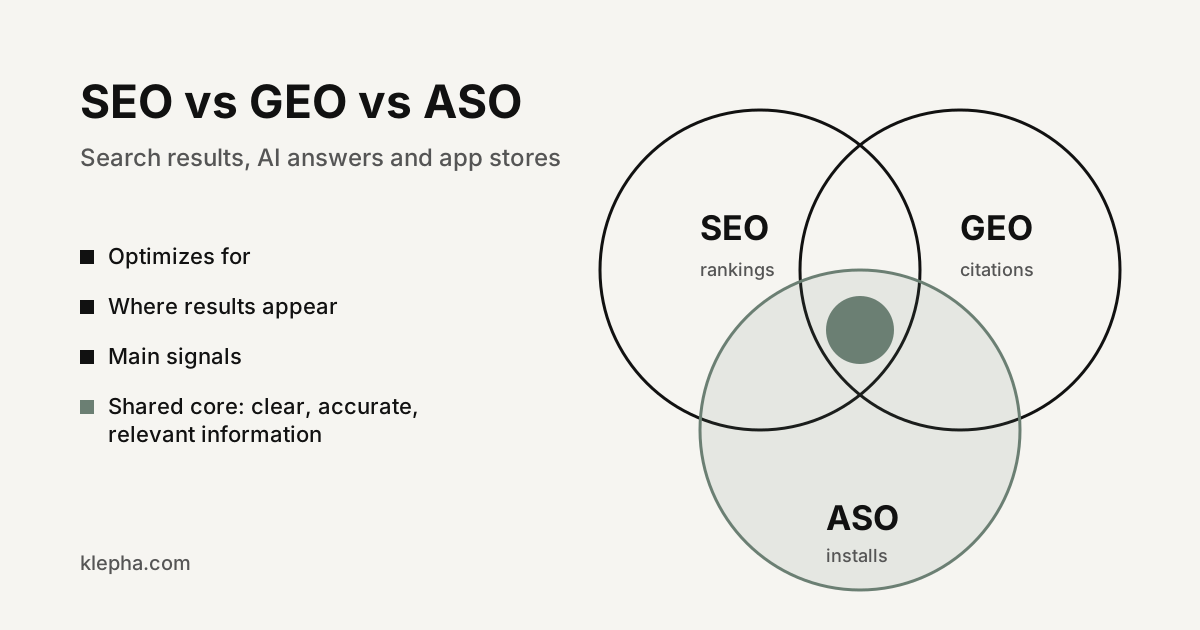
SEO (search engine optimization) helps your website earn visible positions in search engine results so people click through to it. GEO (generative engine optimization) helps your content get quoted and attributed inside answers written by AI assistants, and ASO (app store optimization) helps an app appear for relevant searches in the Apple App Store and Google Play and convince people to install it. All three reward clear, accurate, relevant information, but they live on different surfaces, read different signals and are measured with different tools.
The confusion is understandable. The three terms are often sold together, the tactics sound alike (“use the right keywords,” “write a good description”), and the same marketing team is frequently asked to own all of them. This guide separates them in plain language, using the platforms’ own documentation wherever a rule or number is involved.
Key takeaways
- SEO optimizes for rankings and clicks in search results such as Google and Bing.
- GEO optimizes for being cited or named inside AI generated answers. It builds on SEO rather than replacing it.
- ASO optimizes for search visibility and installs inside the App Store and Google Play, using short, character limited metadata fields.
- Overlap: all three reward relevance, accuracy and genuine user satisfaction, and all three punish keyword stuffing.
- Who needs what: every website needs SEO, most businesses now benefit from GEO, and only companies with a store listed app need ASO.
How do SEO, GEO and ASO compare side by side?
The fastest way to see the difference is to line the three up against the same five questions: what each optimizes for, where the result appears, which signals matter most, who needs it and how success is measured.
| SEO | GEO | ASO | |
|---|---|---|---|
| Optimizes for | Ranking a page for a query so a person clicks through | Being retrieved, quoted and attributed inside an AI answer | Appearing for store searches and turning product page views into installs |
| Where results appear | Search engine results pages (Google, Bing and others) | ChatGPT, Gemini, Perplexity, Claude, Google AI Overviews and AI Mode | Apple App Store and Google Play search, browse and product pages |
| Main signals | Crawlability, indexing, relevance, content quality, links, page experience | Everything SEO needs, plus extractable answers, specific sourced claims and consistent third party description | Title, subtitle or short description, keywords, category, ratings, reviews and downloads |
| Who needs it | Any organization with a website that people search for | Brands whose buyers ask AI assistants for recommendations or explanations | Companies with an app listed in either store |
| How success is measured | Impressions, clicks, positions, organic conversions | Share of AI answers that mention or cite you, plus AI referral traffic | Store impressions, product page conversion rate, downloads, ratings |
The rest of this guide expands each column.
What does SEO optimize for?
Google’s own definition is the clearest: SEO “is about helping search engines understand your content, and helping users find your site and make a decision about whether they should visit your site through a search engine” (Google Search Central, SEO Starter Guide). The unit of success is a page appearing in a list of results for a query, and a person choosing to click it.
In practice SEO has three layers:
- Technical: search engines can crawl the page, render it, index it and show it with a snippet. If this layer fails, nothing else counts. Our technical SEO audit guide walks through the checks.
- Content: the page answers the query better than the alternatives, with a title, headings and body that match what the searcher wants.
- Authority: other sites link to and reference you, which signals that the page is trustworthy.
SEO is the oldest of the three disciplines and the most mature. Its feedback loop is also the most transparent: Search Console reports the queries, impressions, clicks and average positions for your pages, so you can see exactly where you stand.
What does GEO optimize for?
GEO targets a different output. Instead of a list of ten links, an AI assistant writes a single answer and, in many products, attributes parts of it to sources. GEO is the work of making your content the source that gets retrieved, quoted and named. The term was formalized in a 2023 research paper, “GEO: Generative Engine Optimization” by Aggarwal and colleagues, later accepted to KDD 2024, which reported that certain content changes boosted visibility in generative engine responses by up to 40% on the authors’ benchmark. That figure comes from a controlled study, not a promise for any particular site.
Most AI search systems work in two steps. First they retrieve a set of candidate pages, often from a web index. Then the model reads those candidates and selects the passages it finds clearest and most credible. We explain both steps in how LLMs choose which sources to reference.
Why GEO depends on SEO
For Google’s own AI features the dependency is explicit. Google’s documentation “AI features and your website” says that to be eligible as a supporting link in AI Overviews or AI Mode, a page must be indexed and eligible to be shown in Google Search with a snippet, and that there are no additional technical requirements. It also says the same foundational SEO best practices apply. In other words, there is no separate GEO switch to flip at Google: weak SEO limits your AI visibility before any GEO tactic comes into play.
What GEO adds on top
Where GEO goes beyond SEO is in how content is written and how your brand is described elsewhere:
- Extractable answers. A question led heading followed by a two or three sentence answer that makes sense on its own is easier for a model to lift than an answer spread across a page.
- Specific, sourced claims. A dated number with a named source gives the model something concrete to quote and attribute.
- Corroboration. Reviews, comparisons, forums and news that describe your brand consistently shape what assistants say about you, even without a link.
Our generative engine optimization guide covers these tactics in depth, and what to optimize to rank in both search engines and AI assistants breaks them down element by element on a single page.
What does ASO optimize for?
ASO is the odd one out because it happens inside a closed marketplace rather than on the open web. You do not control a web page; you fill in a fixed set of metadata fields in App Store Connect or Play Console, each with a hard character limit, and the store decides where your app appears. The goal has two halves: be found for relevant store searches, and convert the people who view your product page into installs.
How Apple’s App Store ranks apps
Apple’s developer page on App Store search says results are based on a number of factors, including text relevance (matches for your app’s title, subtitle, keywords and primary category) and user behavior (downloads, ratings and reviews, and more). Apple also states that your primary and optional secondary categories are indexed by its search algorithm, and that ratings and reviews can influence how your app ranks.
Several Apple rules are specific enough to change how you write metadata:
- The keyword field takes terms separated by commas with no spaces, and Apple advises not repeating words already in your app name, subtitle or category.
- Promotional text does not affect search ranking, according to Apple, so it should not be used for keywords.
- Competitor app names, unauthorized trademarks and irrelevant terms in keywords are a common reason for rejection.
- Custom product pages can be assigned their own keywords so a tailored page appears for those searches instead of your default page.
- Search results can show app tags that Apple generates with large language models from the metadata you provide, which is one place where ASO and AI quietly meet.
For a step by step method to pick the terms for those fields, see how to choose App Store title and subtitle keywords.
How Google Play ranks apps
Google’s Play Console Help says Play search, similar to a search on Google, takes multiple factors into account, such as app titles, developer names and app descriptions. Its guide to getting discovered adds that apps are ranked on a combination of ratings, reviews, downloads and other factors, and recommends using SEO best practices in your description while respecting Play’s spam and impersonation policies. Google also notes that professionally translating your description can lead to better search results for users worldwide.
Unlike Apple, Google’s store listing setup does not list a separate keyword field: the text fields are the app name, short description and full description. Play’s metadata policy warns that repetitive or irrelevant keyword use can lead to suspension, bans emojis and repeated special characters in the title, and prohibits text that suggests store ranking or price promotions, such as “#1” or “10% off.”
App Store and Google Play text limits
| Field | Apple App Store | Google Play |
|---|---|---|
| App name | 2 to 30 characters | Up to 30 characters |
| Subtitle or short description | Subtitle, up to 30 characters | Short description, up to 80 characters |
| Keywords | Up to 100 bytes, comma separated | No separate field listed |
| Promotional text | Up to 170 characters, editable without a new version, does not affect search ranking | Not applicable |
| Description | Up to 4,000 characters, plain text | Full description, up to 4,000 characters |
Limits from Apple’s App Store Connect Help and Google’s Play Console Help, checked November 8, 2026. Apple’s App Store search page describes the keyword limit as 100 characters while App Store Connect Help states 100 bytes; the byte figure matters for languages whose characters take more than one byte. One detail links ASO back to SEO: Apple notes that the description is used for web search engine results once your app is released, so the store listing is also a web page that search engines can show.
Who needs SEO, GEO or ASO?
The honest answer depends on where your customers start looking. A few common cases:
- A local service business or B2B company with a website and no app. SEO first, because it is the foundation and the most measurable. GEO next, especially if buyers ask assistants questions like “which provider should I use for this.” If you serve customers locally, a complete Google Business Profile belongs in the SEO work. ASO does not apply.
- A publisher, blog or content site. SEO and GEO both, with GEO increasingly important as AI answers summarize informational queries. Our guide to AI SEO content writing covers writing for both readers.
- A mobile first app company. ASO is often the primary acquisition channel, because many installs start with a store search. SEO and GEO still matter for the brand name, reviews and comparison queries that happen before someone opens the store.
- A SaaS company with a web product and companion apps. All three. SEO and GEO for evaluation and comparison queries, ASO for people who already chose you and search the store by name or by task.
If budget forces a choice, start where you already have demand. Check which queries bring impressions in Search Console, whether assistants already mention your category, and whether your store listing gets impressions it fails to convert.
See where you appear in search and AI answers
A free Klepha report checks how your site shows up in search and in assistants such as ChatGPT, Gemini and Perplexity, so you know which gap to work on first.
Get my free reportWhere do SEO, GEO and ASO overlap?
The three disciplines share more than their acronyms suggest. Four overlaps are worth planning around.
Relevance is defined by the words people actually use. Keyword research feeds all three. The phrases people type into Google, ask an assistant and type into an app store search bar are related but not identical: store searches tend to be short and task based, while assistant prompts are longer and conversational. Research each surface separately, then reuse the shared core.
Accuracy and honesty are enforced everywhere. Google’s guidance centers on helpful, reliable, people first content. Apple rejects irrelevant or trademarked keywords. Google Play suspends apps for misleading or repetitive metadata. AI assistants tend to prefer sources that read as balanced rather than promotional. Overclaiming is penalized on every surface, just in different ways.
User satisfaction feeds back into visibility. In app stores this is explicit: Apple and Google both name ratings, reviews and downloads as ranking inputs. On the web it is less direct, but pages that genuinely help people tend to earn links, mentions and repeat visits, which supports both SEO and GEO.
Consistent descriptions travel. Your app store description, your website’s product pages and what reviewers write about you all become material that search engines index and AI assistants read. If your store listing calls the product one thing and your homepage calls it another, every system has a less stable fact to rely on. Describing your product the same way everywhere is the cheapest cross channel improvement available.
How is success measured for each?
Each discipline has its own scoreboard, and mixing them up causes most bad decisions.
| Discipline | Primary data source | Metrics to watch |
|---|---|---|
| SEO | Google Search Console, Bing Webmaster Tools, web analytics | Impressions, clicks, average position, organic conversions |
| GEO | Repeated sampling of AI answers for your target prompts, plus analytics referrals from AI tools | Mention rate, citation rate, share of voice against competitors, accuracy of what is said |
| ASO | App Analytics in App Store Connect, Play Console reporting | Store impressions, product page conversion rate, downloads, ratings |
Two details are easy to miss. First, Google says traffic from AI Overviews and AI Mode is included in the overall “Web” search type of the Search Console Performance report, so Google’s AI features are folded into your SEO numbers rather than reported as a separate GEO line. Second, AI answers vary between identical runs, so a single check is noise. Track a fixed prompt set on a regular schedule and judge the trend; our guide to tracking AI brand visibility explains how.
For ASO, Apple suggests reviewing App Analytics regularly to see the impact of metadata changes, including filtering conversion rate by source to see how many people downloaded from App Store search. Change one field at a time where you can, so you know which edit moved the numbers.
What mistakes come from mixing them up?
Treating GEO as a replacement for SEO. Teams sometimes pause technical SEO to chase AI visibility. For Google’s AI features that is self defeating, since eligibility requires being indexed with a snippet, and other assistants also lean on web retrieval. Fix the foundation first.
Copying web keyword habits into app stores. Long keyword lists that might pass on a blog post are wasted or risky in a store. Apple’s keyword field is capped at 100 bytes and penalizes duplicates, and Google Play warns that repetitive keywords can lead to suspension.
Putting keywords where they do not count. Apple says promotional text does not affect search ranking. Use it for timely messages to people already on your page, not for search terms.
Writing for algorithms instead of people. Every surface here ultimately serves a person deciding whether to click, trust or install. Pages and listings written for that person tend to perform better on all three scoreboards than ones written to game any single system.
Expecting guaranteed placement. No one controls rankings, AI citations or store positions. Anyone promising a guaranteed first place in Google, a guaranteed mention in ChatGPT or a guaranteed top store ranking is describing something outside their control. Better inputs raise the odds; they do not buy outcomes. For a practical next step on the web side, see our ChatGPT ranking and blog ranking services, the expertise behind them and the case studies that show how the work is measured.
Ready to go deeper on one discipline? Our ASO audit checklist walks through an app listing step by step, our guide to building topical authority with content clusters covers the content side of SEO and GEO, and our look at AI Overviews for brand searches shows where SEO and GEO now meet on your own brand name.
Sources
- Google Search Central, “SEO Starter Guide: The Basics”, last updated December 10, 2025, checked November 8, 2026. developers.google.com
- Google Search Central, “AI features and your website”, last updated December 10, 2025, checked November 8, 2026. developers.google.com
- Aggarwal, Murahari, Rajpurohit, Kalyan, Narasimhan and Deshpande, “GEO: Generative Engine Optimization”, arXiv:2311.09735, submitted November 16, 2023, revised June 28, 2024, accepted to KDD 2024. arxiv.org
- Apple Developer, “App Store search”, checked November 8, 2026. developer.apple.com
- Apple Developer, App Store Connect Help, “App information” (name and subtitle limits), checked November 8, 2026. developer.apple.com
- Apple Developer, App Store Connect Help, “Platform version information” (promotional text, description and keyword limits), checked November 8, 2026. developer.apple.com
- Google Play Console Help, “Create and set up your app” (store listing field limits), checked November 8, 2026. support.google.com
- Google Play Console Help, “Get discovered on Google Play search”, checked November 8, 2026. support.google.com
- Google Play Console Help, “App visibility and discovery issues”, checked November 8, 2026. support.google.com
- Google Play Policy Center, “Metadata”, checked November 8, 2026. support.google.com
Frequently asked questions
What is the difference between SEO, GEO and ASO?
They target three different places people look. SEO aims for visible positions in search engine results so people click through to your site. GEO aims to have your content quoted and attributed inside AI generated answers. ASO aims for visibility and installs inside the Apple App Store and Google Play. They share a foundation of clear, accurate, relevant information but use different signals and different measurements.
Is GEO replacing SEO?
No. GEO sits on top of SEO rather than replacing it. Google says the same SEO best practices apply to AI Overviews and AI Mode and that a page must be indexed and eligible to show a snippet to appear as a supporting link. Most AI assistants also retrieve from web indexes, so a page that cannot be found by search is rarely cited.
Do I need ASO if I do not have an app?
No. ASO only applies to apps listed in the Apple App Store or Google Play. If your product is a website, a service or a web app with no store listing, your effort belongs in SEO and GEO. ASO becomes relevant the day you publish a store listing.
What are the App Store and Google Play text limits?
Apple allows an app name of 2 to 30 characters, a subtitle of up to 30 characters, keywords of up to 100 bytes, promotional text of up to 170 characters and a description of up to 4,000 characters. Google Play allows an app name of up to 30 characters, a short description of up to 80 characters and a full description of up to 4,000 characters.
Does one tool measure SEO, GEO and ASO?
Usually not. SEO is measured with Search Console and analytics, ASO with App Store Connect and Play Console reporting, and GEO with tools that sample AI answers for your prompts and record mentions and citations. A shared dashboard can combine them, but the underlying data comes from separate sources.